A tree surgeon struck the garden equivalent of gold when he dug up truffles in a garden in Plymouth. Chris Hunt a 47 year old gardener and tree surgeon was working on the garden of Elaine Keith-Hill when he unearthed the delicacy.
Mr Hunt was clearing undergrowth around mature beech and oak trees at Mrs Keith-Hill's property when he unearthed the truffles.
Truffles are normally found in France and Italy and are gathered between November and May, using specially-trained dogs or boars who locate the fungi by smell. They grow around tree roots - normally oak - by providing and taking vital nutrients from the roots.
In total Chris found 10 truffles weighing about 2 kilos and thought to be worth about £1,000, the honest gardener handed them over to the gardens owner who is now considering selling them.
Showing posts with label Foraging for mushrooms. Show all posts
Showing posts with label Foraging for mushrooms. Show all posts
Monday, 18 August 2008

Monday, 4 August 2008
Foraging for wild mushrooms
I get a lot of e-mails from people new to mushroom foraging asking for advice on how to go about it. So I thought it was about time I put something up on the blog. So here we go.

Wild mushrooms grow throughout the year, but autumn offers the most abundant and varied seasonal eating. From late summer until the first frost, you can gather the likes of penny buns, chanterelles, field mushrooms and dozens of other varieties.
It is only a minority of mushrooms that are good to eat, and there are several varieties that are potentially deadly. Some of the most deadly to be found in the UK are among the Amanita genus with names like “death cap” and “destroying angel” and these can easily be confused for edible varieties.
When collecting fungi, avoid using plastic bags; the lack of air will accelerate the decomposition process and make the mushrooms mushy. Use a basket instead.
Never eat any fungus that you are not absolutely certain has been identified correctly.
When trying any fungus for the first time, only eat it in small amounts to make sure the body can cope with it.
Use a good field guide, but don't rely absolutely on pictures in books - differences between fungi can be difficult to spot. Go out with an experienced guide.
Keep a small fresh portion of any mushroom you eat in the fridge. That way, if there is a reaction, you can easily identify the source.

Wild mushrooms grow throughout the year, but autumn offers the most abundant and varied seasonal eating. From late summer until the first frost, you can gather the likes of penny buns, chanterelles, field mushrooms and dozens of other varieties.
It is only a minority of mushrooms that are good to eat, and there are several varieties that are potentially deadly. Some of the most deadly to be found in the UK are among the Amanita genus with names like “death cap” and “destroying angel” and these can easily be confused for edible varieties.
When collecting fungi, avoid using plastic bags; the lack of air will accelerate the decomposition process and make the mushrooms mushy. Use a basket instead.
Never eat any fungus that you are not absolutely certain has been identified correctly.
When trying any fungus for the first time, only eat it in small amounts to make sure the body can cope with it.
Use a good field guide, but don't rely absolutely on pictures in books - differences between fungi can be difficult to spot. Go out with an experienced guide.
Keep a small fresh portion of any mushroom you eat in the fridge. That way, if there is a reaction, you can easily identify the source.
Monday, 23 June 2008
Forest fires are not all bad news
Professional mushroom pickers have flocked to the Cascade and the Boise National Forest`s in North America this month. Almost 1,000 pickers are camped out to hunt full-time for the morels sprouting in areas burned by last year’s devastating forest fires.
The pickers who come from all over America watch the news and the Internet to see where the picking is best. Many of them travel all year round in search of mushrooms with an experienced mushroom hunter being able to earn $50 - $80 dollars a day.
“It’s hard work,” said a picker named Tony — he declined to give his last name — as he sat around a campfire Sunday near Warm Lake, surrounded by buckets of morels. His tent was pitched beside dozens of others, tied to trees in a burned-out clearing. Blue tarps formed a vast sheltered space where tired pickers rested and chatted around fires.
“But it’s fun and good exercise,” said Koy Chounlabout, a spokeswoman of sorts for the picking community who gives her home as Oregon’s Willamette Valley. “It clears your mind.”
Mark Loseke, who is coordinating the Forest Service’s response to the influx, has never seen this many pickers —not even in the 1980s, when hundreds poured in after forest fires. As of Monday, his office in Cascade had issued 950 commercial permits costing $20 a week, and he expects the applications to keep coming.
The pickers who come from all over America watch the news and the Internet to see where the picking is best. Many of them travel all year round in search of mushrooms with an experienced mushroom hunter being able to earn $50 - $80 dollars a day.
“It’s hard work,” said a picker named Tony — he declined to give his last name — as he sat around a campfire Sunday near Warm Lake, surrounded by buckets of morels. His tent was pitched beside dozens of others, tied to trees in a burned-out clearing. Blue tarps formed a vast sheltered space where tired pickers rested and chatted around fires.
“But it’s fun and good exercise,” said Koy Chounlabout, a spokeswoman of sorts for the picking community who gives her home as Oregon’s Willamette Valley. “It clears your mind.”
Mark Loseke, who is coordinating the Forest Service’s response to the influx, has never seen this many pickers —not even in the 1980s, when hundreds poured in after forest fires. As of Monday, his office in Cascade had issued 950 commercial permits costing $20 a week, and he expects the applications to keep coming.
Monday, 14 April 2008
A Morel dilema?
A man out foraging in the good old US of A struck gold when he stumbled upon a giant Morel crop.
"I've been mushroom hunting since I was a kid," he said. "I've found some big mushrooms before, but nothing like this." said the gob-smacked yank.
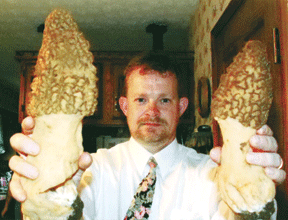
The largest specimen measured more than 12 inches long with a three-inch diameter base. Morel mushrooms are a prized commodity, selling at his local farmer's markets for as much as $35 to $40 per pound.
But like any good mushroom hunter the bloke refused to cash in on his crop - and ate them instead!
Well what else could he do?
"I've been mushroom hunting since I was a kid," he said. "I've found some big mushrooms before, but nothing like this." said the gob-smacked yank.

The largest specimen measured more than 12 inches long with a three-inch diameter base. Morel mushrooms are a prized commodity, selling at his local farmer's markets for as much as $35 to $40 per pound.
But like any good mushroom hunter the bloke refused to cash in on his crop - and ate them instead!
Well what else could he do?
Tuesday, 18 March 2008
Mushroom tells us spring has arrived!
A mushroom that isn't usually seen in Britain for months has emerged in February for the first time on record. Half a dozen Shaggy Inkcaps have burst forth in South Devon after days of sunshine.
Professor Alan Gange, an expert on fungi from the University of London, said: "I am quite astonished by their appearance now and can only assume it is because of the extraordinarily warm weather.

"I have checked our database of 58 years' worth of data and this is the first report of this species fruiting in the spring.
"In our data, the earliest recorded date for the species is June 11."
So, spring is here is it?
Have they looked out of the window??
Professor Alan Gange, an expert on fungi from the University of London, said: "I am quite astonished by their appearance now and can only assume it is because of the extraordinarily warm weather.

"I have checked our database of 58 years' worth of data and this is the first report of this species fruiting in the spring.
"In our data, the earliest recorded date for the species is June 11."
So, spring is here is it?
Have they looked out of the window??
Saturday, 21 July 2007
Looking for mushrooms
"Aaah" we often hear "why should I buy my wild mushrooms from you when they're ... well, wild?".
A good question - but one that's easy to answer.
Although it would make a lovely story, we don't spend our time foraging for mushrooms. Indeed we have a network of growers all over the world who send us their dried mushrooms - we then package them and sell them to discerning mushroom lovers all over the country.
In addition to wild mushrooms we also process fresh mushrooms for sale to the UK food industry - and if you've ever eaten food products containing mushrooms then the chances are that they're ours!
So, you'd expect us to say that we know our mushrooms - but that would be an understatement! We're passionate about mushrooms and barely a day goes by without yours truly enjoying one of nature's finest products.
I have also enjoyed the odd forage too because we're in a part of the country that's bursting with mushrooms - but that's if you know where to look. Of course not everything is as it seems when looking for mushrooms growing wild - so you really need to know your ... ahem .. onions when looking for good fungi.
Here's a website I've found which is a treasure trove of mushroom knowledge - why not check it out before you go hunting http://www.mushrooms.org.uk/.
A good question - but one that's easy to answer.
Although it would make a lovely story, we don't spend our time foraging for mushrooms. Indeed we have a network of growers all over the world who send us their dried mushrooms - we then package them and sell them to discerning mushroom lovers all over the country.
In addition to wild mushrooms we also process fresh mushrooms for sale to the UK food industry - and if you've ever eaten food products containing mushrooms then the chances are that they're ours!
So, you'd expect us to say that we know our mushrooms - but that would be an understatement! We're passionate about mushrooms and barely a day goes by without yours truly enjoying one of nature's finest products.
I have also enjoyed the odd forage too because we're in a part of the country that's bursting with mushrooms - but that's if you know where to look. Of course not everything is as it seems when looking for mushrooms growing wild - so you really need to know your ... ahem .. onions when looking for good fungi.
Here's a website I've found which is a treasure trove of mushroom knowledge - why not check it out before you go hunting http://www.mushrooms.org.uk/.
Subscribe to:
Posts (Atom)


