The world’s largest fungus covers 2,200 acres or the same as 1,665 football pitches and is in America, in the Malheur national forest in Oregon.
American scientists discovered the giant fungus after trees began to die in the forest, and began testing mushroom samples from various locations in the national park. They discovered that all the samples where part of one organism.
Officially known as Armillaria ostoyae or the honey mushroom, the fungus lives three feet underground and the only visible signs are small mushrooms on the surface.
Experts estimate that the giant mushroom is at least 2,400 years old, but could be as old as 7,200 years.
The largest fungus in Europe is in a Swiss National Forest, near the eastern town of Ofenpass.
Spanning 86 acres, the mostly underground fungus is believed to be 1,000 years old and is once again a Honey mushroom.
Showing posts with label Wild Mushrooms. Show all posts
Showing posts with label Wild Mushrooms. Show all posts
Monday, 1 September 2008

Monday, 18 August 2008
Unearthing gold
A tree surgeon struck the garden equivalent of gold when he dug up truffles in a garden in Plymouth. Chris Hunt a 47 year old gardener and tree surgeon was working on the garden of Elaine Keith-Hill when he unearthed the delicacy.
Mr Hunt was clearing undergrowth around mature beech and oak trees at Mrs Keith-Hill's property when he unearthed the truffles.
Truffles are normally found in France and Italy and are gathered between November and May, using specially-trained dogs or boars who locate the fungi by smell. They grow around tree roots - normally oak - by providing and taking vital nutrients from the roots.
In total Chris found 10 truffles weighing about 2 kilos and thought to be worth about £1,000, the honest gardener handed them over to the gardens owner who is now considering selling them.
Mr Hunt was clearing undergrowth around mature beech and oak trees at Mrs Keith-Hill's property when he unearthed the truffles.
Truffles are normally found in France and Italy and are gathered between November and May, using specially-trained dogs or boars who locate the fungi by smell. They grow around tree roots - normally oak - by providing and taking vital nutrients from the roots.
In total Chris found 10 truffles weighing about 2 kilos and thought to be worth about £1,000, the honest gardener handed them over to the gardens owner who is now considering selling them.
Monday, 11 August 2008
Giant puffball
A giant puffball mushroom has been found growing in the garden of a bar in Woonsocket, America. The giant mushroom measuring 1.3 feet tall and 10 inches wide was found by the bar owners son, growing underneath an oak tree.
The bars owner Judy Pelletier said “She was shocked by the size of the mushroom specially considering that this is the first mushroom she has every seen growing in her garden.”
The mushroom is proving something of a hit with patrons and visitors alike who are flocking to the small bar to see the mushroom.

All members of the puffball mushroom family are edible but the bars owner has no plans to eat the mushroom commenting “I will probably throw it out after everyone has looked at it.”
Puffball mushrooms grow to an average of 4 to 28 inches in diameter and can reach diameters of nearly four feet. They can be found growing in meadows and forests in late summer and autumn.
The bars owner Judy Pelletier said “She was shocked by the size of the mushroom specially considering that this is the first mushroom she has every seen growing in her garden.”
The mushroom is proving something of a hit with patrons and visitors alike who are flocking to the small bar to see the mushroom.

All members of the puffball mushroom family are edible but the bars owner has no plans to eat the mushroom commenting “I will probably throw it out after everyone has looked at it.”
Puffball mushrooms grow to an average of 4 to 28 inches in diameter and can reach diameters of nearly four feet. They can be found growing in meadows and forests in late summer and autumn.
Monday, 4 August 2008
Foraging for wild mushrooms
I get a lot of e-mails from people new to mushroom foraging asking for advice on how to go about it. So I thought it was about time I put something up on the blog. So here we go.

Wild mushrooms grow throughout the year, but autumn offers the most abundant and varied seasonal eating. From late summer until the first frost, you can gather the likes of penny buns, chanterelles, field mushrooms and dozens of other varieties.
It is only a minority of mushrooms that are good to eat, and there are several varieties that are potentially deadly. Some of the most deadly to be found in the UK are among the Amanita genus with names like “death cap” and “destroying angel” and these can easily be confused for edible varieties.
When collecting fungi, avoid using plastic bags; the lack of air will accelerate the decomposition process and make the mushrooms mushy. Use a basket instead.
Never eat any fungus that you are not absolutely certain has been identified correctly.
When trying any fungus for the first time, only eat it in small amounts to make sure the body can cope with it.
Use a good field guide, but don't rely absolutely on pictures in books - differences between fungi can be difficult to spot. Go out with an experienced guide.
Keep a small fresh portion of any mushroom you eat in the fridge. That way, if there is a reaction, you can easily identify the source.

Wild mushrooms grow throughout the year, but autumn offers the most abundant and varied seasonal eating. From late summer until the first frost, you can gather the likes of penny buns, chanterelles, field mushrooms and dozens of other varieties.
It is only a minority of mushrooms that are good to eat, and there are several varieties that are potentially deadly. Some of the most deadly to be found in the UK are among the Amanita genus with names like “death cap” and “destroying angel” and these can easily be confused for edible varieties.
When collecting fungi, avoid using plastic bags; the lack of air will accelerate the decomposition process and make the mushrooms mushy. Use a basket instead.
Never eat any fungus that you are not absolutely certain has been identified correctly.
When trying any fungus for the first time, only eat it in small amounts to make sure the body can cope with it.
Use a good field guide, but don't rely absolutely on pictures in books - differences between fungi can be difficult to spot. Go out with an experienced guide.
Keep a small fresh portion of any mushroom you eat in the fridge. That way, if there is a reaction, you can easily identify the source.
Monday, 28 July 2008
Australia could produce 10 times as many truffles
Australian truffle production could grow by as much as 10 times its current level by 2013, but market development and further research will be needed to ensure the industry has a long-term future.
Truffles are unique underground mushrooms that grow on the roots of trees which either naturally host the fungi or have been inoculated with truffle spores..
 Despite being a relatively new crop to Australia, truffles are one of the most highly sought after and valued foods in the world, with Australian truffles currently selling for between $2000 and $3000 per kg. Despite being highly sought after by many chefs, it is not used often due to the considerable cost of purchase.
The cost is so high due to the difficulties with creating the right environment for the truffles to grow.
The most ever paid for a truffle is $330,000 by a casino owner from Macau for a 1.5kg white truffle last year, which Works out to $220,000 per kg.
Truffles are unique underground mushrooms that grow on the roots of trees which either naturally host the fungi or have been inoculated with truffle spores..
 Despite being a relatively new crop to Australia, truffles are one of the most highly sought after and valued foods in the world, with Australian truffles currently selling for between $2000 and $3000 per kg. Despite being highly sought after by many chefs, it is not used often due to the considerable cost of purchase.
The cost is so high due to the difficulties with creating the right environment for the truffles to grow.
The most ever paid for a truffle is $330,000 by a casino owner from Macau for a 1.5kg white truffle last year, which Works out to $220,000 per kg.
Monday, 21 July 2008
Death Angels claim another life
A 61 year old woman has died after eating poisonous wild mushrooms nicknamed death angels that she found growing near a highway rest stop just outside New York City.
Westchester County's health department says Zoila Tapia found the pure-white mushrooms on July 6, in a wooded area along Interstate 684 in Bedford, a town about half an hour north of Manhattan.
The 61-year-old White Plains resident was hospitalised after eating the mushrooms and died 4 days later. The mushrooms are among the prettiest but deadliest in the world.
Westchester County Medical Examiner Dr. Millard Hyland said that by the time Tapia sought medical help, her kidney and liver functions were compromised and her chances for survival were quickly declining.
Westchester County's health department says Zoila Tapia found the pure-white mushrooms on July 6, in a wooded area along Interstate 684 in Bedford, a town about half an hour north of Manhattan.
The 61-year-old White Plains resident was hospitalised after eating the mushrooms and died 4 days later. The mushrooms are among the prettiest but deadliest in the world.
Westchester County Medical Examiner Dr. Millard Hyland said that by the time Tapia sought medical help, her kidney and liver functions were compromised and her chances for survival were quickly declining.
Wednesday, 9 July 2008
Healthy Shiitake
The health benefits of shiitake mushrooms have been exposed recently by an American study.
Scientists in America found that Shiitake mushrooms contain high levels of high molecular weight polyaccharides (HMWP) which is known to improve the human immune system. They also discovered that eritadenine found in shiitake mushrooms may help lower cholesterol levels.
The researchers inoculated logs with spores from three different shiitake varieties and compared the yield with shiitake yields grown on commercial substrates.
They found that the log-grown shiitakes had HMWP levels as much as 70 percent higher than the substrate-grown shiitakes. The team also observed that shiitakes grown on red and white oak logs had higher levels of HMWP than shiitakes grown on sweet gum logs.
In 2004-2005, producers harvested approximately 9 million pounds of shiitake mushrooms, which sold for an average price of $3.21 per pound.

Scientists in America found that Shiitake mushrooms contain high levels of high molecular weight polyaccharides (HMWP) which is known to improve the human immune system. They also discovered that eritadenine found in shiitake mushrooms may help lower cholesterol levels.
The researchers inoculated logs with spores from three different shiitake varieties and compared the yield with shiitake yields grown on commercial substrates.
They found that the log-grown shiitakes had HMWP levels as much as 70 percent higher than the substrate-grown shiitakes. The team also observed that shiitakes grown on red and white oak logs had higher levels of HMWP than shiitakes grown on sweet gum logs.
In 2004-2005, producers harvested approximately 9 million pounds of shiitake mushrooms, which sold for an average price of $3.21 per pound.
Monday, 23 June 2008
Forest fires are not all bad news
Professional mushroom pickers have flocked to the Cascade and the Boise National Forest`s in North America this month. Almost 1,000 pickers are camped out to hunt full-time for the morels sprouting in areas burned by last year’s devastating forest fires.
The pickers who come from all over America watch the news and the Internet to see where the picking is best. Many of them travel all year round in search of mushrooms with an experienced mushroom hunter being able to earn $50 - $80 dollars a day.
“It’s hard work,” said a picker named Tony — he declined to give his last name — as he sat around a campfire Sunday near Warm Lake, surrounded by buckets of morels. His tent was pitched beside dozens of others, tied to trees in a burned-out clearing. Blue tarps formed a vast sheltered space where tired pickers rested and chatted around fires.
“But it’s fun and good exercise,” said Koy Chounlabout, a spokeswoman of sorts for the picking community who gives her home as Oregon’s Willamette Valley. “It clears your mind.”
Mark Loseke, who is coordinating the Forest Service’s response to the influx, has never seen this many pickers —not even in the 1980s, when hundreds poured in after forest fires. As of Monday, his office in Cascade had issued 950 commercial permits costing $20 a week, and he expects the applications to keep coming.
The pickers who come from all over America watch the news and the Internet to see where the picking is best. Many of them travel all year round in search of mushrooms with an experienced mushroom hunter being able to earn $50 - $80 dollars a day.
“It’s hard work,” said a picker named Tony — he declined to give his last name — as he sat around a campfire Sunday near Warm Lake, surrounded by buckets of morels. His tent was pitched beside dozens of others, tied to trees in a burned-out clearing. Blue tarps formed a vast sheltered space where tired pickers rested and chatted around fires.
“But it’s fun and good exercise,” said Koy Chounlabout, a spokeswoman of sorts for the picking community who gives her home as Oregon’s Willamette Valley. “It clears your mind.”
Mark Loseke, who is coordinating the Forest Service’s response to the influx, has never seen this many pickers —not even in the 1980s, when hundreds poured in after forest fires. As of Monday, his office in Cascade had issued 950 commercial permits costing $20 a week, and he expects the applications to keep coming.
Monday, 9 June 2008
Unidentified Giant Mushroom Mystery
A Suffolk gardener has discovered a giant mushroom measuring 2-3 inches in diameter growing against a tree in her garden in Langham near Bury.
The surprised nature lover Cilia Simms and her husband Peter first noticed the giant mushroom at the weekend and have been trying unsuccessfully every since to identify the giant mushroom.
Cilla Simms explains “When I saw how big it was, it gave me goosebumps. We have had two or three mushrooms against the tree but I have never seen anything like this before. I think my garden was once a meadow as it has always been a bit wild. But this is a mystery and it is really fascinating.”

If you can help Mrs Simms identify the giant mushroom then please leave a comment.
The surprised nature lover Cilia Simms and her husband Peter first noticed the giant mushroom at the weekend and have been trying unsuccessfully every since to identify the giant mushroom.
Cilla Simms explains “When I saw how big it was, it gave me goosebumps. We have had two or three mushrooms against the tree but I have never seen anything like this before. I think my garden was once a meadow as it has always been a bit wild. But this is a mystery and it is really fascinating.”

If you can help Mrs Simms identify the giant mushroom then please leave a comment.
Monday, 2 June 2008
Mushrooms - the great insulator?
Mushrooms could soon be used to insulate homes. That's right. An American company has invented a pioneering product called (not very inventively) "Greensulation".
The product is currently undergoing testing, but its makers say it could potentially hit the market as soon as 2010.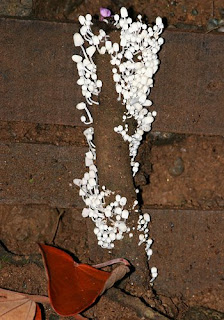
These chaps have produced an insulator using our friend the mushroom - plus rice hulls and recycled paper. When mixed together with water and hydrogen peroxide, placed in plastic containers and put in a dark place it then literally grows into shape.
So now not only can you insulate yourself against the cold with a piping hot bowl of wild mushroom soup - you can put the stuff into your homes and keep the whole family warm!
The product is currently undergoing testing, but its makers say it could potentially hit the market as soon as 2010.

These chaps have produced an insulator using our friend the mushroom - plus rice hulls and recycled paper. When mixed together with water and hydrogen peroxide, placed in plastic containers and put in a dark place it then literally grows into shape.
So now not only can you insulate yourself against the cold with a piping hot bowl of wild mushroom soup - you can put the stuff into your homes and keep the whole family warm!
Tuesday, 27 May 2008
Another four down!
Four more people have died and six others are in hospital in the Central Highlands of Vietnam after eating poisonous mushrooms.
A woman in the family, Y Vung, said she had picked white and tasty-looking mushrooms in the mountain believing they were edible.
When will these people ever learn? To be really safe, I suggest you buy your wild mushrooms from our friends at Wild about Mushrooms?
A woman in the family, Y Vung, said she had picked white and tasty-looking mushrooms in the mountain believing they were edible.
When will these people ever learn? To be really safe, I suggest you buy your wild mushrooms from our friends at Wild about Mushrooms?
Monday, 14 April 2008
A Morel dilema?
A man out foraging in the good old US of A struck gold when he stumbled upon a giant Morel crop.
"I've been mushroom hunting since I was a kid," he said. "I've found some big mushrooms before, but nothing like this." said the gob-smacked yank.
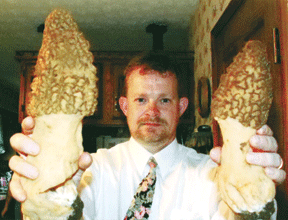
The largest specimen measured more than 12 inches long with a three-inch diameter base. Morel mushrooms are a prized commodity, selling at his local farmer's markets for as much as $35 to $40 per pound.
But like any good mushroom hunter the bloke refused to cash in on his crop - and ate them instead!
Well what else could he do?
"I've been mushroom hunting since I was a kid," he said. "I've found some big mushrooms before, but nothing like this." said the gob-smacked yank.

The largest specimen measured more than 12 inches long with a three-inch diameter base. Morel mushrooms are a prized commodity, selling at his local farmer's markets for as much as $35 to $40 per pound.
But like any good mushroom hunter the bloke refused to cash in on his crop - and ate them instead!
Well what else could he do?
Friday, 28 March 2008
Into war - against pollution!
In the war against ocean pollution, environmentalists have turned to the humble mushroom. Mushrooms have a unique ability to take dead things and make them pretty again by turning decomposed matter into nutrients. In fact, they’re so adept at tearing down and rebuilding chemical compounds that even oil spills are no match for their natural abilities.

In November 2007, when an oil tanker sprang a leak in San Francisco Bay, 58,000 gallons of oil seeped into the water and beaches. A group of local activists decided to take the clean-up into their own hands, using a technique originally developed to dispose of used motor oil. They headed for the shore and laid out mats made of human hair that were covered in oyster mushrooms. The hair quickly soaked up all the oil, while the mushrooms digested the dangerous chemicals. Within 12 weeks, only harmless compost remained.
The process is so simple and cost-effective that grass roots organizations and local governments are now calling for it to be recognised as a way to clean up contaminated soil on old factory sites.

In November 2007, when an oil tanker sprang a leak in San Francisco Bay, 58,000 gallons of oil seeped into the water and beaches. A group of local activists decided to take the clean-up into their own hands, using a technique originally developed to dispose of used motor oil. They headed for the shore and laid out mats made of human hair that were covered in oyster mushrooms. The hair quickly soaked up all the oil, while the mushrooms digested the dangerous chemicals. Within 12 weeks, only harmless compost remained.
The process is so simple and cost-effective that grass roots organizations and local governments are now calling for it to be recognised as a way to clean up contaminated soil on old factory sites.
Tuesday, 18 March 2008
Mushroom tells us spring has arrived!
A mushroom that isn't usually seen in Britain for months has emerged in February for the first time on record. Half a dozen Shaggy Inkcaps have burst forth in South Devon after days of sunshine.
Professor Alan Gange, an expert on fungi from the University of London, said: "I am quite astonished by their appearance now and can only assume it is because of the extraordinarily warm weather.

"I have checked our database of 58 years' worth of data and this is the first report of this species fruiting in the spring.
"In our data, the earliest recorded date for the species is June 11."
So, spring is here is it?
Have they looked out of the window??
Professor Alan Gange, an expert on fungi from the University of London, said: "I am quite astonished by their appearance now and can only assume it is because of the extraordinarily warm weather.

"I have checked our database of 58 years' worth of data and this is the first report of this species fruiting in the spring.
"In our data, the earliest recorded date for the species is June 11."
So, spring is here is it?
Have they looked out of the window??
Monday, 3 March 2008
Is nothing sacred????
Two highly distinctive ornaments have been stolen from a garden in the Midlands Two 3ft-high stone mushrooms!
Police say the mushrooms, which are quite heavy (no!! really?), were bought from a company in the south of England when the owners were on holiday and are not known to be made in the Midlands.
For goodness sake – where are they?
They must be found!
Police say the mushrooms, which are quite heavy (no!! really?), were bought from a company in the south of England when the owners were on holiday and are not known to be made in the Midlands.
For goodness sake – where are they?
They must be found!
Tuesday, 26 February 2008
No comment required
Sometimes ... just sometimes, I come across a wild mushroom story that takes my breath away.
I found this on You Tube.
And I'm just speechless.
And before you ask - no, it isn't me!!
I found this on You Tube.
And I'm just speechless.
And before you ask - no, it isn't me!!
Wednesday, 12 December 2007
Light up your life with Mushrooms!
I found this whilst hanging around for my Wild Mushroom Omelette this morning!
With the arrival of Japan’s rainy season, a mysterious type of green, glow-in-the-dark mushroom begins to sprout in Wakayama prefecture. The Mycena lux-coeli mushrooms, known locally as shii no tomobishi-dake, sprout from fallen chinquapin trees.

As they grow, a chemical reaction occurs, causing them to glow a ghostly green.
The luminescent mushrooms were long believed to be indigenous solely to Tokyo’s Hachijojima Island after they were discovered there in the early 1950s. In 1995, however, mycologists found the fungus growing wild in coastal areas of the southern Kii peninsula, as well as in Kyushu and other areas.
All sounds a bit funny to me!
With the arrival of Japan’s rainy season, a mysterious type of green, glow-in-the-dark mushroom begins to sprout in Wakayama prefecture. The Mycena lux-coeli mushrooms, known locally as shii no tomobishi-dake, sprout from fallen chinquapin trees.

As they grow, a chemical reaction occurs, causing them to glow a ghostly green.
The luminescent mushrooms were long believed to be indigenous solely to Tokyo’s Hachijojima Island after they were discovered there in the early 1950s. In 1995, however, mycologists found the fungus growing wild in coastal areas of the southern Kii peninsula, as well as in Kyushu and other areas.
All sounds a bit funny to me!
Saturday, 1 December 2007
For goodness sake .... wild means wild!!
It must be a quiet news week!
The latest crackpot idea from scientists hit the news stands this week with the news that mushrooms could come from trucks. Yep, you heard right.
From trucks!
Apparently, a new concept, known as Made in Transit would see foods, such as mushrooms actually being grown on board trucks on the way to the supermarket. Distributors could become farmers turning their trucks into high density growing facilities and reprogramming what big business see as a waste of time into growing (ie more profit) time.
Here's what the news report said "Our obsession with fresh food irrespective of season and location fuels constant developments in extending their life after the moment of harvest until the point of consumption. Ripening is manipulated through the removal or addition of the ripening gas ethylene, and breathing is slowed down through extensive refrigeration and through modified atmosphere packaging. But these so-called post-harvest technologies are not only economically and ecologically expensive, they are essentially damage control measures that only slow the eventual deterioration down.
‘Made in Transit’ proposes to shift the paradigm from preserving freshness to enabling growth along the way, a shift from ‘best before’ to ‘ready by’ for perishable goods. Growing food on the way would mean it gets better as it travels and that it would be still alive upon arrival, ready for harvest by the consumer (bypassing harvest labour, which for mushrooms can account for 40% of overall production cost). Applied to mushrooms, it also could mean other unexpected things, like more diversity in our supermarkets as some of the most fragile mushrooms (too fragile to withstand transport) could theoretically become available anywhere by growing them on the way. The global industry already shapes our food—thickening a tomato’s wall so it can withstand rough handling, or growing watermelons square so they stack more efficiently. Humans created this global condition. The next step is when the global market starts to produce our food, literally."
For goodness sake, why don't they just leave us - and nature - alone?
Wild mushrooms are called wild mushrooms because they ... errmm .... grow wild.
Or should we just go the whole hog and change their name to Suzuki Fungus?
The latest crackpot idea from scientists hit the news stands this week with the news that mushrooms could come from trucks. Yep, you heard right.
From trucks!
Apparently, a new concept, known as Made in Transit would see foods, such as mushrooms actually being grown on board trucks on the way to the supermarket. Distributors could become farmers turning their trucks into high density growing facilities and reprogramming what big business see as a waste of time into growing (ie more profit) time.
Here's what the news report said "Our obsession with fresh food irrespective of season and location fuels constant developments in extending their life after the moment of harvest until the point of consumption. Ripening is manipulated through the removal or addition of the ripening gas ethylene, and breathing is slowed down through extensive refrigeration and through modified atmosphere packaging. But these so-called post-harvest technologies are not only economically and ecologically expensive, they are essentially damage control measures that only slow the eventual deterioration down.
‘Made in Transit’ proposes to shift the paradigm from preserving freshness to enabling growth along the way, a shift from ‘best before’ to ‘ready by’ for perishable goods. Growing food on the way would mean it gets better as it travels and that it would be still alive upon arrival, ready for harvest by the consumer (bypassing harvest labour, which for mushrooms can account for 40% of overall production cost). Applied to mushrooms, it also could mean other unexpected things, like more diversity in our supermarkets as some of the most fragile mushrooms (too fragile to withstand transport) could theoretically become available anywhere by growing them on the way. The global industry already shapes our food—thickening a tomato’s wall so it can withstand rough handling, or growing watermelons square so they stack more efficiently. Humans created this global condition. The next step is when the global market starts to produce our food, literally."
For goodness sake, why don't they just leave us - and nature - alone?
Wild mushrooms are called wild mushrooms because they ... errmm .... grow wild.
Or should we just go the whole hog and change their name to Suzuki Fungus?
Friday, 16 November 2007
But beat this for extravagance!!
From the Bangkok Nation November 16th 2007
Air Force to probe 'mushrooms flight'
The Royal Thai Air Force will investigate allegations that a helicopter crew used their aircraft to collect wild mushrooms from a relative in Kanchanaburi, a deputy spokesman for the service said.
Group Captain Monthol Satchukorn said the Air Force had set up a committee to investigate allegations the flight crew, from unit 2034 at the Kamphaeng Saen Aviation School in Nakhon Pathom, abused their position to go on the unorthodox mission.
He said the unit, whose main responsibility is search and rescue, often did practice missions to designated training zones in Nakhon Pathom, Ratchaburi and parts of Kanchanaburi.
At the time of the alleged mushroom incident, the helicopter crew was undergoing flying and landing training in Kanchanaburi. Monthol said the probe committee would find out if the pilots abandoned their helicopter to collect the mushrooms as alleged. If the flight crew members were found to have broken the rules, they would be punished according to the degree of wrongdoing, he said.
The case emerged after a resident of Tambon Nong Khao in Kanchanaburi's Than Muang district, who asked not to be named, filed a complaint with three photos of the mushroom pick-up to a Thai newspaper on Wednesday, saying officials use the state helicopter for inappropriate activity.
The resident claimed the helicopter circled around the area for 10 minutes on Tuesday morning before landing in a ricefield near Wat Nong Khao.
Villagers to rush to help, believing the crew had been forced to land there.
Five uniformed officials got out of the helicopter followed by two pilots, one of whom explained to villagers he was a pilot training at Kamphaeng Saen Aviation School.
Two days earlier, his mother phoned to get him to collect mushrooms at his home in Tambon Nong Khao, he told villagers. And as they flew the helicopter by the area he had landed to collect them from his mother.
The resident said the group then boarded a pick-up and drove off, leaving the helicopter unguarded - till then came back an hour later.
One of the photos submitted to the paper showed officials on the back of a pick-up going away from the helicopter amid a crowd of onlookers.
Air Force to probe 'mushrooms flight'
The Royal Thai Air Force will investigate allegations that a helicopter crew used their aircraft to collect wild mushrooms from a relative in Kanchanaburi, a deputy spokesman for the service said.
Group Captain Monthol Satchukorn said the Air Force had set up a committee to investigate allegations the flight crew, from unit 2034 at the Kamphaeng Saen Aviation School in Nakhon Pathom, abused their position to go on the unorthodox mission.
He said the unit, whose main responsibility is search and rescue, often did practice missions to designated training zones in Nakhon Pathom, Ratchaburi and parts of Kanchanaburi.
At the time of the alleged mushroom incident, the helicopter crew was undergoing flying and landing training in Kanchanaburi. Monthol said the probe committee would find out if the pilots abandoned their helicopter to collect the mushrooms as alleged. If the flight crew members were found to have broken the rules, they would be punished according to the degree of wrongdoing, he said.
The case emerged after a resident of Tambon Nong Khao in Kanchanaburi's Than Muang district, who asked not to be named, filed a complaint with three photos of the mushroom pick-up to a Thai newspaper on Wednesday, saying officials use the state helicopter for inappropriate activity.
The resident claimed the helicopter circled around the area for 10 minutes on Tuesday morning before landing in a ricefield near Wat Nong Khao.
Villagers to rush to help, believing the crew had been forced to land there.
Five uniformed officials got out of the helicopter followed by two pilots, one of whom explained to villagers he was a pilot training at Kamphaeng Saen Aviation School.
Two days earlier, his mother phoned to get him to collect mushrooms at his home in Tambon Nong Khao, he told villagers. And as they flew the helicopter by the area he had landed to collect them from his mother.
The resident said the group then boarded a pick-up and drove off, leaving the helicopter unguarded - till then came back an hour later.
One of the photos submitted to the paper showed officials on the back of a pick-up going away from the helicopter amid a crowd of onlookers.
Thursday, 8 November 2007
Don't say you weren't warned!
We all know that mushrooms are the finest food in the world - but we also know that you need to be extremely careful about eating fungus.
Especially if you're unsure of the variety.
And even more especially if you're told the fungus is poisonous!

I found this report from the Spanish press:
A 45 year old man from Fuentes de León in Badajoz, José Manuel Hidalgo, ate some mushrooms to show they were not poisonous, and ended up in intensive care.
It happened last Sunday during an open day being held in the village, which had been proceeded by a day of mushroom collecting and display.
The victim got into an argument with other locals as to how lethal wild mushrooms could be, with a poster warning that as little as 20 grams could be fatal. José Manuel did not believe it, and suddenly to prove his point, started to eat the ‘amanita phalloides’ mushroom. On the second bite he showed symptoms of being drunk, and continued to claim the mushroom was not fatal.
An ambulance was called but it took considerable argument before the patient finally agreed to be taken to hospital in Zafra, Badajoz. By this time he had turned yellow and started to vomit.
He spent two days in the intensive care unit, and finally was allowed out onto the ward on Tuesday afternoon amid concerns that his liver may have suffered permanent damage.
So there you go - if your pals say 'No!' they're probably right!
Especially if you're unsure of the variety.
And even more especially if you're told the fungus is poisonous!

I found this report from the Spanish press:
A 45 year old man from Fuentes de León in Badajoz, José Manuel Hidalgo, ate some mushrooms to show they were not poisonous, and ended up in intensive care.
It happened last Sunday during an open day being held in the village, which had been proceeded by a day of mushroom collecting and display.
The victim got into an argument with other locals as to how lethal wild mushrooms could be, with a poster warning that as little as 20 grams could be fatal. José Manuel did not believe it, and suddenly to prove his point, started to eat the ‘amanita phalloides’ mushroom. On the second bite he showed symptoms of being drunk, and continued to claim the mushroom was not fatal.
An ambulance was called but it took considerable argument before the patient finally agreed to be taken to hospital in Zafra, Badajoz. By this time he had turned yellow and started to vomit.
He spent two days in the intensive care unit, and finally was allowed out onto the ward on Tuesday afternoon amid concerns that his liver may have suffered permanent damage.
So there you go - if your pals say 'No!' they're probably right!
Subscribe to:
Posts (Atom)


