Professional mushroom pickers have flocked to the Cascade and the Boise National Forest`s in North America this month. Almost 1,000 pickers are camped out to hunt full-time for the morels sprouting in areas burned by last year’s devastating forest fires.
The pickers who come from all over America watch the news and the Internet to see where the picking is best. Many of them travel all year round in search of mushrooms with an experienced mushroom hunter being able to earn $50 - $80 dollars a day.
“It’s hard work,” said a picker named Tony — he declined to give his last name — as he sat around a campfire Sunday near Warm Lake, surrounded by buckets of morels. His tent was pitched beside dozens of others, tied to trees in a burned-out clearing. Blue tarps formed a vast sheltered space where tired pickers rested and chatted around fires.
“But it’s fun and good exercise,” said Koy Chounlabout, a spokeswoman of sorts for the picking community who gives her home as Oregon’s Willamette Valley. “It clears your mind.”
Mark Loseke, who is coordinating the Forest Service’s response to the influx, has never seen this many pickers —not even in the 1980s, when hundreds poured in after forest fires. As of Monday, his office in Cascade had issued 950 commercial permits costing $20 a week, and he expects the applications to keep coming.
Monday, 23 June 2008

Tuesday, 17 June 2008
Giant morel found
American Charley Robinson has found a giant morel measuring 17 inches in girth and weighing 1.25 pounds, he said.
''I have been trying to find out what the records are for morels, but so far have struck out. I have found references to some around a pound, but none as large as mine, though I don't doubt that there are some.''
Mr Robinson 61 has been searching for morels for more than three decades near his home in Sanford and couldn't believe his eyes when they focused on the giant fungi near his cabin. Robinson let the mushroom grow for 10 days before picking it confident that know one else would find it.
''I have learned not to pick them until they feel a little dry,'' Robinson said. ''That is when they quit growing. It was still growing when I picked it. But I didn't want to risk someone else finding it.''
''It sure dwarfed the others that grew in the same area, even though they were all above average size,'' Robinson said.
Robinson said the exact location where he found the mushroom is ''classified.''
''I have hunted morels most of my life and have it down to a science,'' Robinson said. ''I have always found them in areas that had been burned over.

''I have been trying to find out what the records are for morels, but so far have struck out. I have found references to some around a pound, but none as large as mine, though I don't doubt that there are some.''
Mr Robinson 61 has been searching for morels for more than three decades near his home in Sanford and couldn't believe his eyes when they focused on the giant fungi near his cabin. Robinson let the mushroom grow for 10 days before picking it confident that know one else would find it.
''I have learned not to pick them until they feel a little dry,'' Robinson said. ''That is when they quit growing. It was still growing when I picked it. But I didn't want to risk someone else finding it.''
''It sure dwarfed the others that grew in the same area, even though they were all above average size,'' Robinson said.
Robinson said the exact location where he found the mushroom is ''classified.''
''I have hunted morels most of my life and have it down to a science,'' Robinson said. ''I have always found them in areas that had been burned over.

Monday, 9 June 2008
Unidentified Giant Mushroom Mystery
A Suffolk gardener has discovered a giant mushroom measuring 2-3 inches in diameter growing against a tree in her garden in Langham near Bury.
The surprised nature lover Cilia Simms and her husband Peter first noticed the giant mushroom at the weekend and have been trying unsuccessfully every since to identify the giant mushroom.
Cilla Simms explains “When I saw how big it was, it gave me goosebumps. We have had two or three mushrooms against the tree but I have never seen anything like this before. I think my garden was once a meadow as it has always been a bit wild. But this is a mystery and it is really fascinating.”

If you can help Mrs Simms identify the giant mushroom then please leave a comment.
The surprised nature lover Cilia Simms and her husband Peter first noticed the giant mushroom at the weekend and have been trying unsuccessfully every since to identify the giant mushroom.
Cilla Simms explains “When I saw how big it was, it gave me goosebumps. We have had two or three mushrooms against the tree but I have never seen anything like this before. I think my garden was once a meadow as it has always been a bit wild. But this is a mystery and it is really fascinating.”

If you can help Mrs Simms identify the giant mushroom then please leave a comment.
Monday, 2 June 2008
Mushrooms - the great insulator?
Mushrooms could soon be used to insulate homes. That's right. An American company has invented a pioneering product called (not very inventively) "Greensulation".
The product is currently undergoing testing, but its makers say it could potentially hit the market as soon as 2010.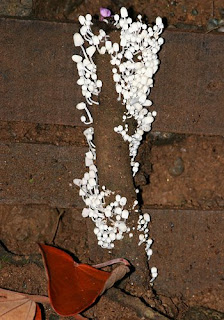
These chaps have produced an insulator using our friend the mushroom - plus rice hulls and recycled paper. When mixed together with water and hydrogen peroxide, placed in plastic containers and put in a dark place it then literally grows into shape.
So now not only can you insulate yourself against the cold with a piping hot bowl of wild mushroom soup - you can put the stuff into your homes and keep the whole family warm!
The product is currently undergoing testing, but its makers say it could potentially hit the market as soon as 2010.

These chaps have produced an insulator using our friend the mushroom - plus rice hulls and recycled paper. When mixed together with water and hydrogen peroxide, placed in plastic containers and put in a dark place it then literally grows into shape.
So now not only can you insulate yourself against the cold with a piping hot bowl of wild mushroom soup - you can put the stuff into your homes and keep the whole family warm!
Tuesday, 27 May 2008
Another four down!
Four more people have died and six others are in hospital in the Central Highlands of Vietnam after eating poisonous mushrooms.
A woman in the family, Y Vung, said she had picked white and tasty-looking mushrooms in the mountain believing they were edible.
When will these people ever learn? To be really safe, I suggest you buy your wild mushrooms from our friends at Wild about Mushrooms?
A woman in the family, Y Vung, said she had picked white and tasty-looking mushrooms in the mountain believing they were edible.
When will these people ever learn? To be really safe, I suggest you buy your wild mushrooms from our friends at Wild about Mushrooms?
Monday, 14 April 2008
A Morel dilema?
A man out foraging in the good old US of A struck gold when he stumbled upon a giant Morel crop.
"I've been mushroom hunting since I was a kid," he said. "I've found some big mushrooms before, but nothing like this." said the gob-smacked yank.
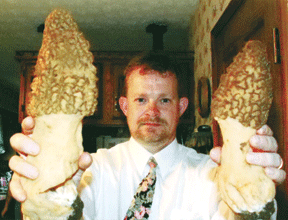
The largest specimen measured more than 12 inches long with a three-inch diameter base. Morel mushrooms are a prized commodity, selling at his local farmer's markets for as much as $35 to $40 per pound.
But like any good mushroom hunter the bloke refused to cash in on his crop - and ate them instead!
Well what else could he do?
"I've been mushroom hunting since I was a kid," he said. "I've found some big mushrooms before, but nothing like this." said the gob-smacked yank.

The largest specimen measured more than 12 inches long with a three-inch diameter base. Morel mushrooms are a prized commodity, selling at his local farmer's markets for as much as $35 to $40 per pound.
But like any good mushroom hunter the bloke refused to cash in on his crop - and ate them instead!
Well what else could he do?
Friday, 28 March 2008
Into war - against pollution!
In the war against ocean pollution, environmentalists have turned to the humble mushroom. Mushrooms have a unique ability to take dead things and make them pretty again by turning decomposed matter into nutrients. In fact, they’re so adept at tearing down and rebuilding chemical compounds that even oil spills are no match for their natural abilities.

In November 2007, when an oil tanker sprang a leak in San Francisco Bay, 58,000 gallons of oil seeped into the water and beaches. A group of local activists decided to take the clean-up into their own hands, using a technique originally developed to dispose of used motor oil. They headed for the shore and laid out mats made of human hair that were covered in oyster mushrooms. The hair quickly soaked up all the oil, while the mushrooms digested the dangerous chemicals. Within 12 weeks, only harmless compost remained.
The process is so simple and cost-effective that grass roots organizations and local governments are now calling for it to be recognised as a way to clean up contaminated soil on old factory sites.

In November 2007, when an oil tanker sprang a leak in San Francisco Bay, 58,000 gallons of oil seeped into the water and beaches. A group of local activists decided to take the clean-up into their own hands, using a technique originally developed to dispose of used motor oil. They headed for the shore and laid out mats made of human hair that were covered in oyster mushrooms. The hair quickly soaked up all the oil, while the mushrooms digested the dangerous chemicals. Within 12 weeks, only harmless compost remained.
The process is so simple and cost-effective that grass roots organizations and local governments are now calling for it to be recognised as a way to clean up contaminated soil on old factory sites.
Subscribe to:
Posts (Atom)


